Enterprise software factory
Issues in. Merged PRs out.
Coding assistants make one engineer faster. Orchestra is the factory: AI agent pipelines on your GitHub repos that must prove every stage — plan, implement, review — before your code merges.
The category
Not a faster engineer. A different machine.
Every AI coding tool on the market accelerates one engineer at one keyboard. Orchestra changes the unit of work: an issue goes in, and a verified, reviewed, merged pull request comes out.
AI coding tools
A copilot per engineer
Assistants and coding agents accelerate one person at one keyboard. Throughput still scales with headcount.
Trusts the model's word
"Done" means the agent said so. Nothing checks the claim until a human reads the diff.
Starts cold on every repo
Each session begins knowing nothing about your codebase's history, standards, or past failures.
Output: suggestions
Drafts and diffs that still queue for an engineer to shepherd through review and merge.
An enterprise software factory
A pipeline per issue
Orchestra runs the whole unit of work unattended: plan, implement, review, merge — one production line per issue.
Verifier-gated by design
A stage completes when a deterministic check passes — build exits 0, tests pass, review approved — never because an agent claimed it.
Learns your repo from every run
Decision logs, review verdicts, and outcomes feed the next run's briefing. Performance on your repo compounds.
Output: merged PRs
Reviewed, verified, merged pull requests — with the evidence for every gate kept on the record.
The pipeline
One run, four gates.
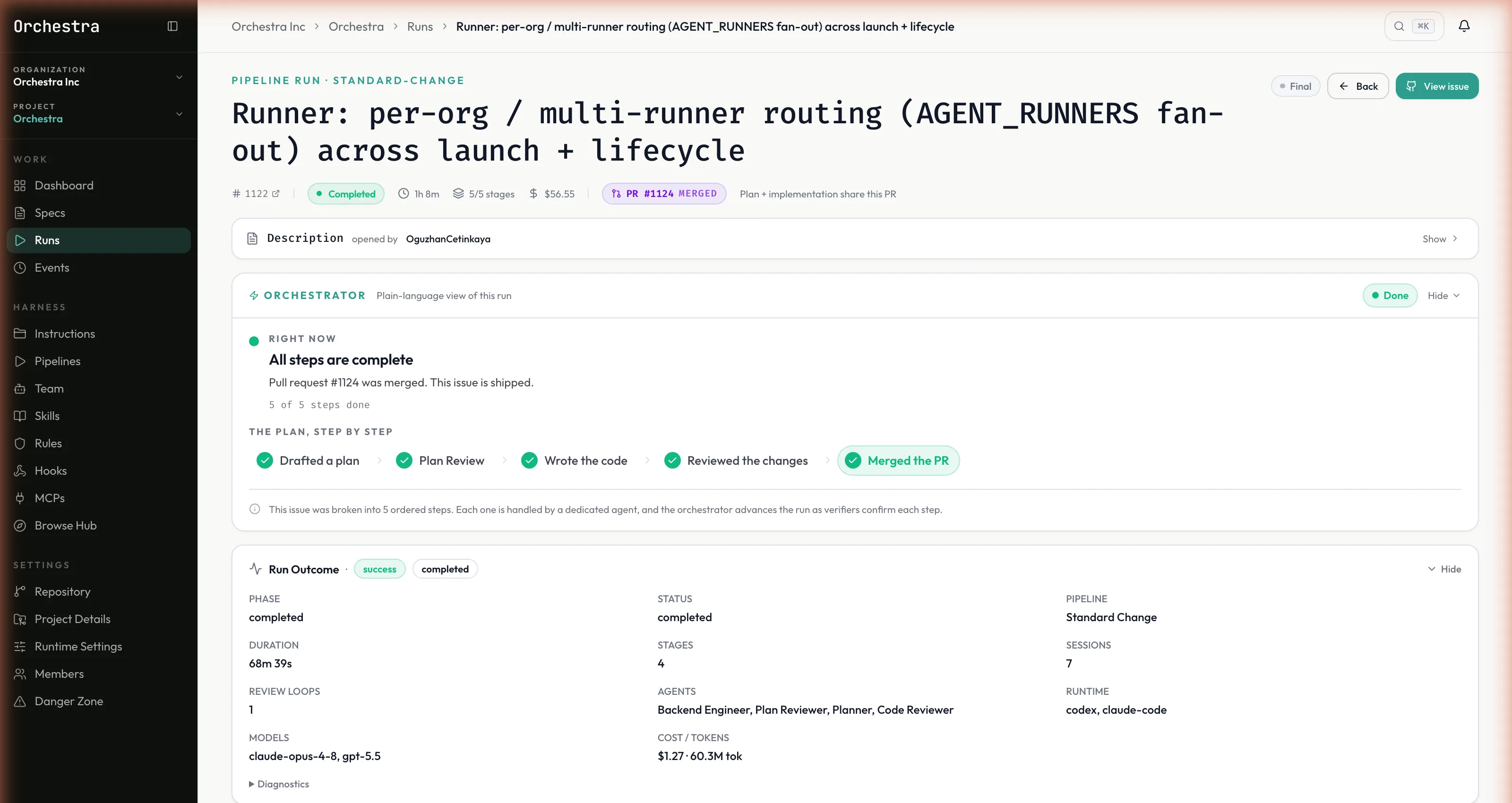
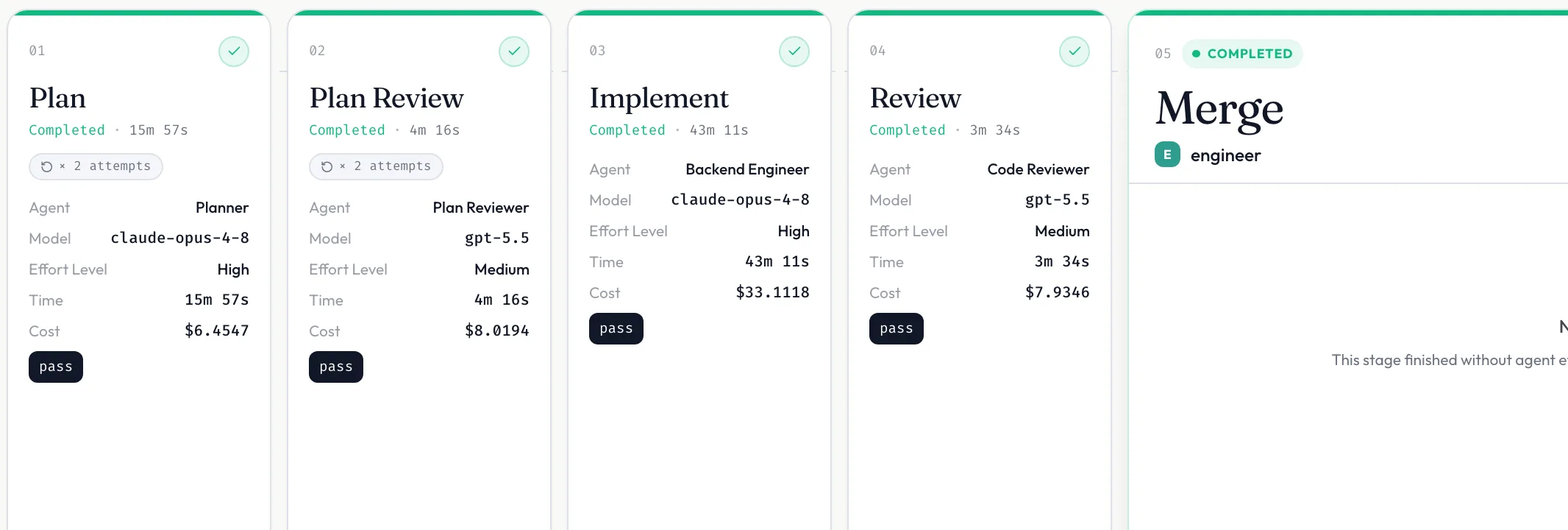
Start a run from a GitHub issue. The Orchestrator writes a briefing for each stage, dispatches a specialist agent, and only advances when the stage's verifier passes.
Plan
An engineer agent reads the issue and opens a pull request carrying the implementation plan.
Implement
The agent pushes the change onto the plan's PR, behind the repo's build and test gates.
Review
A reviewer on a different provider files findings. Rejected work loops straight back to implement.
Merge
The Orchestrator merges the pull request once every gate has passed, and keeps the evidence.
Review findings loop the run back to implement until the reviewer approves. Every briefing, dispatch, and verdict lands in an append-only decision log.
The workforce
A team of specialists, not a single bot.
Each stage is dispatched to a role-specific agent with its own briefing, skills, and model, running on Claude Code, Codex, or OpenCode.
The machinery
The harness around the run.
Pipelines your project owns
Standard Change, Quick, Advanced Feature, and Investigation ship built in. Clone one, then edit stages, roles, and gates per project.
Verifier gates
A stage is complete when its verifier says so, not when the agent does.
Components from the Hub
Install skills, agents, hooks, MCP servers, and rules per project. They materialize into the agent's worktree at launch.
Isolated sandboxes
Every session runs Claude Code, Codex, or OpenCode inside its own Docker container. Watch, stop, or restart the whole fleet.
Decisions on the record
An append-only decision log, live session activity, and per-run cost, kept for every run your team starts.
Why it holds
Three claims copilots cannot copy.
Each one requires owning the orchestration layer — not a feature a per-seat assistant can bolt on.
The verification spine
Completion contracts, dispatch gates, and CI-provenance test checks run through every pipeline. Agents must prove completion — a claim autocomplete tools and generic agents cannot make without rebuilding their architecture.
Compounding repo knowledge
Orchestra owns the runs, so it owns the outcome data: every rejection, verdict, and merge becomes repo-specific knowledge. The system gets stronger as the underlying models improve — it sits above them, not beside them.
Governance enterprises can buy
Roles are permission boundaries — your reviewer cannot push. Every decision is logged to an auditable identity with per-role, per-run cost. Enterprises buy guarantees, not personalities.
Limited early access
Bring us the work you want to ship.
We are opening Orchestra in small cohorts while we scale the sandbox fleet and work closely with early teams. Tell us what you want to automate; we review verified applications manually.
01
Apply in about two minutes.
02
Verify your email so we know it is you.
03
Approved teams receive a one-time account link.
Already approved? Sign in to Orchestra.